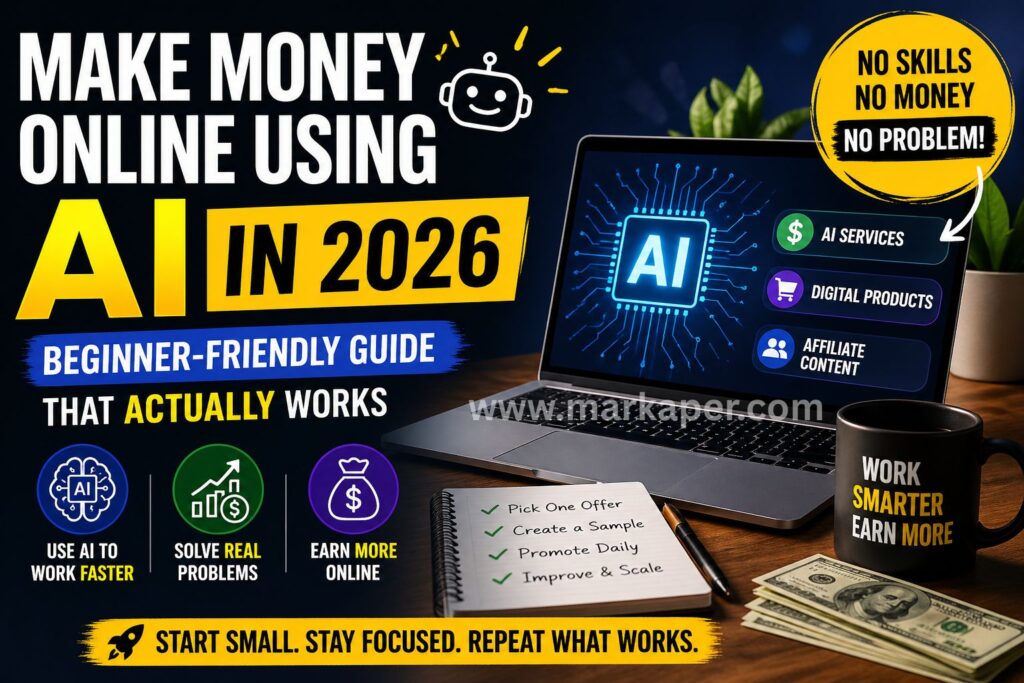
Everyone is talking about AI, but a lot of beginners still haven’t made a single dollar with it. If you feel buried under tool lists, YouTube promises, and flashy screenshots, you’re not behind, you’re stuck in the same cycle that blocks most people trying to make money online with AI in 2026.
The usual mistakes are easy to spot. People bounce between five tools, paste raw AI output that sounds robotic, and chase random side hustles with no plan, so nothing gets traction. After a few weeks, it feels like AI is working for everyone else, when the real problem is simple: AI only pays when it helps you solve a real problem faster and better.
This beginner guide cuts through the hype and shows you practical ways to start making money online using AI, even if you’re starting from zero. First, you’ll see which AI income methods make sense for beginners in 2026, and which ones are a waste of your time.
Key Takeaways
- Beginners make money online with AI by selling a clear result, not by selling access to an AI tool.
- The fastest path to first income is usually an AI-assisted service for a specific customer type, such as social posts, email copy, or short-form video editing.
- Digital products and affiliate content can scale, but they usually take longer to produce steady income than services.
- The best beginner system is simple: pick one offer, create one sample, promote it daily, and improve based on feedback.
- AI helps most when it speeds up drafting, design, or editing, but human review is still what makes the final work useful and sellable.
“This post may contain affiliate links. Read our disclosure for more info.”
Start with the right mindset, AI is a tool, not the business
If you’re trying to make money online with AI in 2026, this mindset will save you months of wasted effort. AI is not the business model. It is the helper. The business is the result you deliver, the problem you solve, and the people willing to pay for that outcome.
A lot of beginners get stuck because they chase tools instead of income. They learn prompts, test apps, and watch trend videos, but they never build one simple offer people can buy. If you want real progress, keep it practical: choose one service or product, use AI to do the heavy lifting faster, then improve the final result with your own judgment.
What Make Money Online with AI really looks like in 2026
The realistic model is simple. You pick one offer, use AI to speed up the work, edit it so it sounds human, and repeat that process until it becomes routine. That is how beginners start earning, whether they sell blog posts, short-form video scripts, product descriptions, email copy, or simple content packages for small businesses.
Businesses do not care that you used a prompt well. They care about outcomes. They want more leads, more sales, better content, and less wasted time. So instead of selling “AI content,” sell a clear result. For example, offer five social posts for a local gym, a weekly email for an online store, or refreshed product copy for a small shop.

A good working rhythm looks like this:
- Pick one problem people already pay to solve.
- Use AI to create a fast first draft.
- Edit the output so it is useful, clear, and on-brand.
- Deliver the work, gather feedback, and improve the next round.
That loop is boring compared to hype videos, but boring is often what pays. In other words, the win comes from speed plus quality plus repetition, not from sounding technical.
The people who make money with AI usually sell a clear result, not access to a tool.
The biggest beginner mistakes that waste time and kill trust
Most people do not fail because AI “doesn’t work.” They fail because they use it in ways that make them look careless. Trust drops fast online, and once that happens, sales get harder.
One common mistake is writing vague prompts and expecting strong output. If your instructions are messy, the result will be messy too. Be specific about the audience, goal, tone, and format. Clear input gives you far better material to work with.
Another mistake is posting copy-paste AI content with little or no editing. Readers can spot stiff writing fast. So can clients. Fix the structure, add examples, tighten weak lines, and remove generic fluff before anything goes live.
Many beginners also keep switching ideas every week. One week it is Etsy, the next week it is YouTube, then affiliate marketing, then freelancing. That pattern feels productive, but it kills momentum. Pick one lane and stay with it long enough to learn what actually sells.
A big trust killer is selling tools instead of outcomes. Most clients do not want “AI automation” or “prompt engineering.” They want more booked calls, better posts, faster replies, or less admin work. Your offer should sound like a solution, not a software demo.
Finally, people quit too early. They try one offer, send a few messages, get no response, and stop. Early results are often slow because you’re still learning how to package, pitch, and improve the work. Stick with one offer long enough to get real feedback, then refine it.
A simple way to avoid these mistakes is to keep asking one question: What useful result am I helping someone get? When that answer is clear, your offer gets stronger, your messaging gets easier, and AI becomes what it should be, a tool that helps you deliver faster.
Choose one beginner-friendly AI income path you can start this week
If you’re still bouncing between ideas, pick one path and give it your full focus for the next 7 days. That alone puts you ahead of most beginners who spend weeks testing tools and never make an offer, publish a product, or post a single piece of content.
The best starter path depends on what you want most right now. If you want the fastest shot at first income, sell a simple service. If you want something you can sell more than once, build a small digital product. If you’re playing the longer game, use AI to create content that grows affiliate income over time.
Sell AI-powered services to small businesses
For most beginners, services are the fastest first income path because you do not need traffic, a large audience, or a big product catalog. You just need one clear offer and a few people to pitch. Local businesses already need help with content, follow-up, and simple marketing tasks, and AI helps you do that work faster.
Start with services that are easy to learn and cheap to deliver. Good examples include blog writing, social posts, email copy, simple chatbot setup, and short-form video editing. These are practical problems, and small businesses often care more about saving time than how you made the work.

A beginner-friendly offer could look like this:
- A monthly package of 8 social posts for a local gym
- One weekly promo email for a small online store
- A basic FAQ chatbot for a service business
- Three edited short videos per week for a real estate agent
The early income range is often realistic enough to matter. Many beginners land $500 to $3,000 per month by signing 2 to 10 small clients, depending on pricing, outreach, and quality. Simple content services may start around $100 to $300 per client per month, while chatbot setup or video packages can go higher. Results vary, of course, and your earnings depend on your niche, your pitch, and how well you improve the final output.
If you need cash flow fast, a simple service beats a complicated business model almost every time.
The key is to sell the outcome, not the tool. A bakery does not want “AI copywriting.” It wants better posts, more orders, and fewer hours spent writing captions. That is what makes the pitch easier and the service easier to buy.
Create digital products once and sell them again and again
If you like the idea of building something once and getting paid more than once, digital products are a strong option. They take more patience than services because you need listings, product-market fit, and some way to get eyes on the offer. Still, they can scale better because each sale does not require new client work.
The easiest products to start with are small, useful, and niche. You do not need to build a huge course. In many cases, simple products sell faster because buyers know exactly what they are getting.
Popular beginner options include:
- Prompt packs for writers, marketers, job seekers, or Etsy sellers
- Planners, trackers, and printable worksheets
- Social media templates and content kits
- Low-content books and journals
- Short niche guides sold as PDFs

Platforms like Etsy, Gumroad, and Amazon KDP make this easy to test without much upfront cost. You can use AI to outline a guide, draft product copy, generate ideas for templates, or speed up design planning. Then you clean it up, make it useful, and package it for a specific buyer. If you’re starting with no budget at all, you can start a digital product business with zero investment using free tools and organic traffic.
This path usually starts slower. Some beginners make very little in the first month, while others build to $500 to $5,000 per month after a few months of consistent listings and promotion. Those numbers are possible, but they are not automatic. Strong niches, better thumbnails, clearer titles, and steady traffic matter a lot.
If you go this route, focus on one audience. A “student budget planner” is easier to sell than a generic planner. A “50 real estate caption prompts” pack is easier to buy than a vague prompt bundle. Clear use cases win.
Use AI to grow affiliate income with content
For a site with an affiliate focus, this is one of the smartest long-term paths. You use AI tools for affiliate marketing to help create content that attracts the right readers, then recommend tools that solve real problems. When someone clicks your link and buys, you earn a commission.
This works well for beginners because AI can speed up content production. You can use it to draft blog posts, comparison articles, product roundups, email content, Pinterest descriptions, graphic ideas, or faceless video scripts. That said, speed is only useful if the content is honest and helpful. Raw AI copy usually sounds flat, and weak reviews kill trust.

A simple system looks like this:
- Pick one tool or problem-focused topic.
- Use AI to draft the structure and first version.
- Add your own insights, examples, pros, and limits.
- Edit the piece so it sounds human and useful.
- Add your affiliate link where it fits naturally.
For example, you might write a post comparing AI writing tools for beginners, send a follow-up email with your recommended pick, and repurpose the same idea into Pinterest graphics or a short video script. One idea can feed several channels, which helps you publish more without starting from scratch every time.
The timeline is slower than services, but the upside grows over time. Many beginners earn little or nothing at first, then build toward $300 to $500 per month by the end of the first year if they keep publishing useful content. Some affiliate programs also pay recurring commissions, which means one good post can keep earning after you hit publish.
If this is your lane, keep your standards high. Use AI for drafts and research support, but keep the review honest, add real opinions, and fix every weak line before it goes live. That is how affiliate content earns clicks, sales, and repeat readers.
A simple step-by-step system to make your first AI income online
Trying to make money online with AI can feel messy fast. Most beginners don’t fail because the tools are bad, they fail because they chase too many ideas at once. A simple system fixes that.
The goal is not to build a big business on day one. The goal is to get your first proof of income, learn what people respond to, and repeat what works. If you keep it narrow, AI can help you move a lot faster.
Step 1, pick one offer and one type of customer
Start small and stay specific. When you try to sell content, design, video editing, prompts, templates, and automation all at once, your message gets weak and buyers get confused.
Pick one offer and one customer type. For example, you could write social posts for local gyms, create email promos for real estate agents, or sell Etsy wedding templates to wedding planners. Each one is simple, clear, and easy to explain.

Focus on the outcome, not the tool. A gym owner doesn’t want “AI writing.” They want more consistent posts and less time spent staring at Instagram. A wedding planner doesn’t want “AI design help.” They want polished templates they can sell or use right away.
A good test is simple: can you describe your offer in one sentence? If yes, you’re on the right track. If not, narrow it down until you can.
Clear offers sell faster because people understand them without extra explanation.
Step 2, use AI to create a fast sample or starter product
Once your offer is clear, build one sample fast. This could be a mini portfolio piece, a mock client example, or a starter product you can list online. You are not waiting for permission. You are creating proof.
If you offer a service, make a sample pack. For instance, write three sample social posts for a fictional gym, or create five product descriptions for a fake skincare shop. If you want to sell digital products, make one useful version first, such as a wedding seating chart template or a social media caption bundle.

AI helps you get the draft done quickly. Tools like ChatGPT can outline copy, Canva can speed up design, and CapCut AI can help with short-form video edits. Still, don’t post the raw output. Clean it up, fix weak lines, make it sound human, and shape it for the buyer.
That last part matters most. AI gives you speed, but your edits create value.
Step 3, get traffic or clients every day
Now you need eyeballs. There are two simple paths, and both work.
The first path is outreach, which is best for services. Message local businesses, email prospects, post your sample work on LinkedIn, and create simple gigs on Fiverr or Upwork. Keep your pitch short. Show the result you can help with, then include one sample.
The second path is content, which works better for long-term traffic. Publish SEO blog posts, post short videos, share before-and-after samples, or create simple tutorials that lead to your offer. One helpful piece of content can keep bringing clicks long after you publish it.

The key is daily action. Send five messages. Post one sample. Publish one useful piece of content. Perfection slows you down, but consistency builds momentum.
Step 4, improve what works and turn it into repeat income
Your first win might be small, and that’s fine. One reply, one sale, one happy buyer, that is enough data to improve.
Track what gets attention. Notice which offer gets replies, which sample gets clicks, and which product gets saved or bought. Then build on that. If one gym post package sells, turn it into a monthly plan. If one template gets traction, make a bundle around the same buyer.
As proof builds, raise prices slowly and make your work easier to repeat. A one-off job can become a retainer. A custom design can become a template pack. A simple service can turn into a productized offer with the same steps each time.
That’s how first AI income grows. You don’t need a huge audience or advanced systems. You need one clear offer, one useful sample, daily promotion, and the discipline to keep improving the parts that already work.
Best AI tools for beginners in 2026, and how each one helps you earn
Most beginners waste time here. They download random AI tools, test a few prompts, and still have no offer, no product, and no income. The fix is simple: use a small stack of beginner-friendly tools that help you produce work people already pay for.
If you want to make money online using AI in 2026, start with tools that match clear outcomes. Write faster, design faster, edit faster, then package that speed into a service, a digital product, or affiliate content. The tools below are easy to learn, but your real edge comes from how you use them, edit the output, and tie them to buyer demand.
Writing and research tools for content, client work, and affiliate posts
For most beginners, ChatGPT is the best place to start because it helps with the work that shows up everywhere online. You can use it to draft blog posts, build outlines, write cold emails, create YouTube scripts, brainstorm lead magnets, and generate content ideas when you’re staring at a blank page.

That matters because writing often turns into income first. A beginner can use ChatGPT to help produce:
- affiliate blog drafts
- client social captions
- email newsletters
- product descriptions
- short video scripts
The tool saves time, but prompt clarity decides the quality. If your prompt is vague, the output will sound vague too. Give it the audience, goal, tone, format, and any examples you want it to follow. Then rewrite the weak parts before you publish or send anything to a client.
ChatGPT gives you the first draft fast. Human editing is what makes it worth paying for.
A simple way to monetize it is to pair one task with one buyer. Write affiliate posts for your site, offer caption packs to local businesses, or sell blog and email bundles on freelance platforms. Claude and similar tools can help with planning and long-form writing too, but most beginners only need one strong writing tool to start.
Design and product tools for templates, graphics, and printables
If writing helps you sell words, Canva AI helps you sell visuals. It’s one of the easiest tools for beginners because you don’t need formal design skills to create polished assets that people actually buy.

You can use Canva AI to create YouTube thumbnails, Pinterest pins, lead magnets, Etsy listing images, checklists, planners, and simple digital downloads. That opens up two clear income paths. First, you can sell design work as a service. Second, you can build digital products once and sell them again and again.
Beginners usually do best when they keep the product simple and useful. Good examples include:
- printable planners for a niche audience
- social media templates for small businesses
- PDF lead magnets for coaches and freelancers
- Etsy listing bundles with mockups and graphics
Canva AI speeds up layout ideas, background cleanup, and visual consistency. Still, you need to make the final product feel clean and specific. A generic planner gets ignored. A wedding vendor inquiry tracker or a real estate Instagram template pack gets attention because the use case is clear. If your work leans heavily on custom image styles, Midjourney can help generate original visuals, but Canva is usually the better first tool for getting paid quickly.
Video and voice tools for faceless content and client services
Video is one of the fastest ways to turn AI into cash, especially if you don’t want to show your face. CapCut is the easiest starting point for short-form edits, while Runway is useful when you want more control or extra visual effects. Add ElevenLabs for voiceovers, and you can build full faceless videos without recording your own voice.

This combo works because it fits real offers people already buy. You can edit short videos for creators, make faceless YouTube content, produce simple ad creatives for local brands, or sell monthly content packages to small businesses. One script from ChatGPT can become a short video, a voiceover, and a client deliverable in the same afternoon.
CapCut helps beginners move fast with auto-captions, basic cleanup, and quick editing. Runway gives you more creative options when you want better visuals or AI-assisted effects. ElevenLabs adds realistic voiceovers that sound far better than the robotic audio most people expect.
A beginner offer could be as simple as:
- Write a 30-second script.
- Edit stock clips into a short video.
- Add an ElevenLabs voiceover.
- Deliver three to five videos as a weekly package.
That kind of package is easy to understand, easy to sell, and easy to repeat. If you want one clear next step, pick one of these tool stacks and build a sample today. Speed matters, but a clean final result is what gets the sale.
Real examples, common objections, and the smartest next step
By this point, you can probably see the pattern. People who make money online with AI usually are not doing anything flashy. They pick one simple offer, use AI to speed up the work, and stay consistent long enough to get proof.
That matters because beginners often quit too early. They expect fast cash, hit a slow week, and assume the method is broken. In most cases, the better move is to lower the hype, raise the consistency, and focus on one practical next step.
What realistic beginner success can look like
Real beginner wins usually look small at first, and that is a good sign. A modest first sale, one client, or a few affiliate clicks is often the start of something you can repeat.
For example, one beginner might use ChatGPT plus Canva to build a niche fitness planner, list it on Etsy, and make a few sales in the first month. That is believable. It is also enough to learn which titles, thumbnails, and keywords get attention. Another person might make a simple prompt pack for job seekers, price it low, and improve the listing after each sale.

The same goes for services. A beginner video editor could use ChatGPT for hooks and CapCut for quick edits, then offer three short videos per week to a local gym or cafe. The first client may only pay a few hundred dollars, but that one deal can turn into a monthly retainer if the videos help the business post more often and get more reach.
Affiliate content can start just as quietly. You publish one useful post around a tool you actually understand, add honest pros and limits, and support it with a few Pinterest pins or short videos made with AI. At first, you may only see a handful of clicks. Still, one useful article can keep working long after you hit publish.
Real progress often looks boring at the start, and that is usually a good sign.
What if you have no skills, no money, or no audience
This is where most people talk themselves out of starting. The truth is simpler. You do not need coding skills, a paid team, or a big following to begin.
Many beginner-friendly AI tools have free plans or low-cost entry points. ChatGPT, Canva, CapCut, and similar tools let you test ideas before you spend much. That means you can build a sample, create a portfolio piece, or publish your first content without a big upfront risk.
If you feel like you have no skills, start with a skill that is easy to practice in public. Write three sample social posts. Make one short video for a fake local brand. Build one useful digital download for a narrow audience. Skill grows faster when you make real things, not when you keep watching tutorials.
No audience is also not a deal breaker. You can build trust with:
- Clear sample work that shows what you can do
- Helpful content that answers a real question
- Direct outreach to people who already need the result
- Honest positioning instead of inflated claims
The same rule applies if money is tight. Start with the path that needs the least setup. Services usually win here because you can pitch first, get paid, and then upgrade tools later if needed. You do not need a huge audience to land a client. You need a clear offer and enough proof to make someone feel safe saying yes.
Your best next move after reading this guide
Do not leave this guide with five ideas and no action. Pick one income path, choose one simple tool stack, and take one step in the next 24 hours.
A smart setup for most beginners looks like this:
- Choose one path, service, digital product, or affiliate content.
- Choose one tool stack, such as ChatGPT + Canva or ChatGPT + CapCut.
- Create one real asset today, a sample, a listing, or a publish-ready post.
- Send it out, publish it, or pitch it before tomorrow ends.

If you want the best odds of making money online with AI in 2026, go narrow. One offer beats a pile of ideas. One tool stack beats a messy workflow. One action today beats another week of research.
Conclusion
If you’ve felt stuck, the fix is simpler than the hype makes it sound. Beginners make money online using AI in 2026 when they stop chasing every new tool and focus on one real problem they can solve faster.
That was the core lesson all the way through this guide. Pick one offer, use AI to speed up the work, edit it well, and keep showing it to the right people until you get traction. Confidence comes from proof, and proof starts with one clear action.
So take the realistic next step today. Create one sample, one listing, or one post, then get it in front of someone who might pay for the result.
Read Also: 26 Faceless Business Ideas You Can Start Today With AI (No Camera Needed)
Frequently Asked Questions About Making Money Online Using AI in 2026
What is the fastest way for a beginner to make money with AI in 2026?
For most beginners, selling a simple AI-assisted service is the fastest path. The article points to offers like social posts, email copy, chatbot setup, and short-form video editing because they solve clear business problems and do not require a large audience to start.
Can you make money with AI if you have no experience?
Yes, but the starting point needs to stay narrow. The article recommends choosing one offer, building one sample, and using AI to speed up the draft while you improve the final result yourself. That makes it easier to practice a real skill and get proof of demand.
Which AI income path is best for beginners, services, digital products, or affiliate content?
Services are the best option for fast cash flow because you can pitch clients right away. Digital products can scale better over time, while affiliate content usually takes the longest because traffic and trust build slowly. The best choice depends on whether you want quick income or long-term growth.
What AI tools should beginners start with?
The guide recommends starting with a small tool stack tied to a clear outcome. ChatGPT works well for writing and idea generation, Canva AI helps with templates and visuals, and CapCut can support short-form video work. One focused stack is better than testing too many tools at once.
Do you need an audience to make money online using AI?
No, not for the first steps. The article explains that beginners can start with direct outreach, freelance platforms, or simple sample work instead of waiting to build a large following. An audience helps later, but a clear offer and useful proof matter more at the start.
Affiliate Disclosure (FTC Compliant)
In accordance with the Federal Trade Commission’s guidelines, please assume that some of the links on this website are affiliate links. This means that I may earn a commission if you click on a link and make a purchase, at no additional cost to you.
As an affiliate, I only promote products and services that I have either used personally or thoroughly researched and believe will add value to my readers. Any compensation received does not influence the content, topics, or recommendations made on this website.
I am a participant in various affiliate advertising programs, including but not limited to programs designed to provide a means for websites to earn advertising fees by advertising and linking to products or services.
Please understand that your decision to purchase any product or service is entirely your own responsibility, and you should conduct your own due diligence before making any financial decisions.
If you have any questions regarding this disclosure, feel free to contact me.
Thank you for supporting this website.
This Post is Last Updated On July 27, 2026
About The Author
