Faceless Business Ideas You Can Start Today With AI in 2026
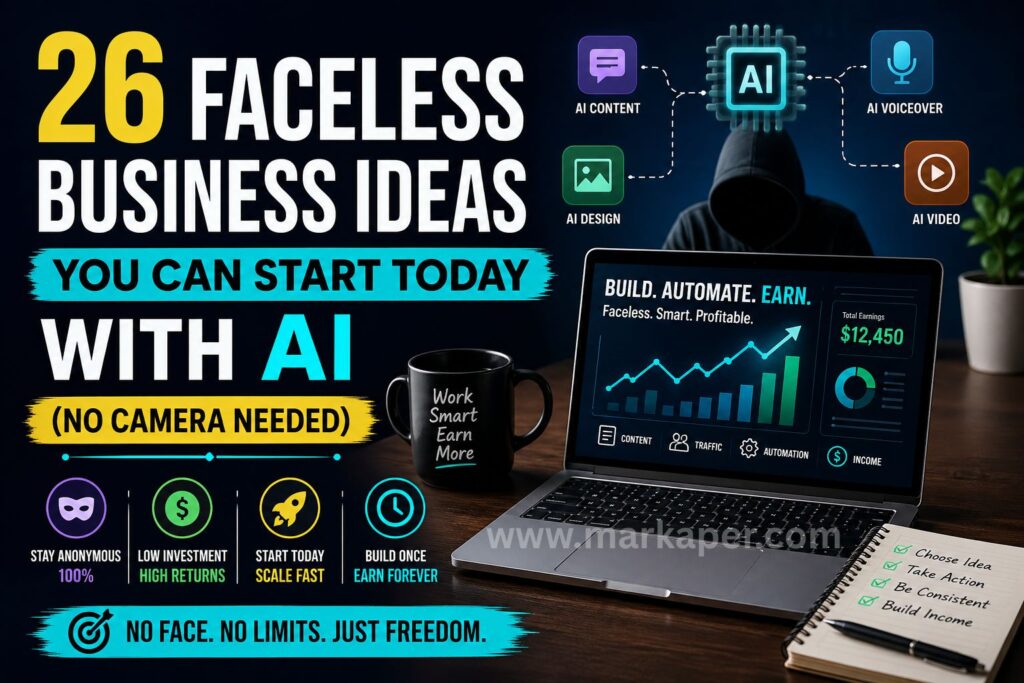
You can make money online without showing your face, building a personal brand, or filming yourself, and that matters more in 2026 than ever. Faceless business ideas are growing fast because AI tools and automation now handle the heavy lifting for content, design, voice, and even customer support.
If you want a low-pressure way to start, you’re in the right place. This guide gives you 26 practical ideas you can start now, plus a quick way to spot the best options for beginners, low budgets, and fast launches.
Key Takeaways
- Faceless business ideas let people start online without showing their face, building a personal brand, or filming on camera.
- AI makes these businesses easier to launch because it can help with writing, design, voiceovers, editing, and support tasks.
- The fastest ideas for beginners are digital products, prompt bundles, Pinterest affiliate marketing, and AI blog content.
- Service-based faceless businesses, like voiceovers, SEO, and email copywriting, can bring in money faster than content-only models.
- Long-term income usually comes from assets that keep working after launch, such as blogs, newsletters, YouTube channels, and digital products.
“This post may contain affiliate links. Read our disclosure for more info.”
Why faceless businesses are blowing up right now
Faceless businesses are growing because they remove some of the biggest barriers that stop people from starting. You do not need to become a public figure, record yourself on camera, or build a brand around your personal life.
That matters more now than ever. Recent data shows faceless channels make up a rising share of new online creator businesses, and AI has made them much easier to run at speed.

What makes a business truly faceless
A faceless business is one you can run without putting your face or identity at the center of it. You do not need on-camera presence, personal branding, or a public persona to make it work.
That does not mean the business feels cold or generic. Many faceless models still use voiceovers, text posts, graphics, screen recordings, stock footage, or AI avatars to connect with your audience. The point is simple, you stay behind the scenes while the content, product, or service does the talking.
This setup works well if you value privacy, want less pressure, or just hate being on video. It also gives you more room to focus on what matters, which is building something useful. Instead of selling your image, you sell information, convenience, entertainment, or a result.
Why AI makes these ideas easier to launch
AI lowers the skill barrier fast. You can use it to write scripts, build blog posts, outline offers, create images, edit video, generate voiceovers, and answer customer messages without doing every task manually.
That saves time, but it also helps you test ideas faster. Instead of spending days building one product, you can create a simple version in a few hours, publish it, and see if people care.
For example, AI can help you:
- Draft blog content and product descriptions
- Generate thumbnails, graphics, and social posts
- Create voiceovers for videos and reels
- Edit short-form video clips more quickly
- Write email replies and basic support messages
- Automate simple steps like lead capture or delivery
In practice, that means you can start lean and improve as you go. You do not need advanced design skills or a full team. You need a clear niche, a simple offer, and the discipline to keep publishing.
How much money you can realistically make
The income range is wide, and that is the honest answer. Some faceless businesses bring in a few hundred dollars a month at first, especially while traffic is still small or your offers are new.
Others can grow into several thousand dollars per month when you stay consistent and build systems. That usually happens when you have a steady traffic source, a clear monetization path, and content that keeps working for you over time.
A good way to think about it is this:
- Side income often comes first, and it can help cover tools or ad spend
- Part-time income usually follows once you have repeat traffic or sales
- Full-time income is possible when you stack content, offers, and automation
You should not expect instant results, because faceless businesses still need effort. However, they can scale well because your work does not depend on your face, your schedule, or your live presence. That makes them one of the most realistic ways to start small and build up with AI.
The fastest faceless ideas you can start with very little money
If you want a quick start, focus on ideas that use free or low-cost tools, simple content, and clear paths to monetization. The best options below let you build quietly in the background, then earn through traffic, downloads, affiliate links, or repeat sales.
These are strong fits if you want to start small and test fast. You can begin with a laptop, a niche, and a few hours of focused work.
AI blog plus affiliate marketing

You can publish helpful articles, rank in search, and earn commissions when readers click your product links. That makes this one of the best long-term faceless models, because your articles can keep working after you publish them.
It also fits affiliate marketing readers well. You create content around problems people already search for, then point them to tools, software, or products that solve those problems. A solid post can bring traffic for months, sometimes longer, without any camera work or daily posting.
Digital product shop
You can sell simple products like checklists, planners, templates, guides, and mini toolkits. These are easy to make, easy to package, and easy to improve once you see what buyers want.
Platforms like Gumroad, Etsy, and Shopify make it simple to start without a big budget. You can create one useful file, list it, and start testing demand before you build a bigger catalog.
This model works best when you solve one clear problem. A budget tracker for freelancers, a meal planner for busy parents, or a content checklist for creators can all sell well if they save time.
ChatGPT prompt bundles
Prompt packs are one of the fastest faceless ideas to launch because you can build them around a niche fast. Marketers, business owners, students, and creators all buy prompts that help them write faster, brainstorm better, or finish tasks with less effort.
You can package them as PDFs or digital downloads and sell them again and again. That gives you a simple product with low overhead and no shipping, inventory, or live sales calls.
The key is to make them specific. A prompt bundle for real estate agents, Etsy sellers, or job seekers will usually feel more useful than a broad generic pack.
Canva template shop
Canva makes it easy to create social media templates, lead magnets, presentations, and Pinterest graphics. Once you build a clean set of designs, you can sell them as ready-to-use packs for people who want speed over starting from scratch.
This is a smart option if you like design but want to keep things simple. Buyers want polished templates they can edit in minutes, so your job is to make their life easier.
You can sell packs for coaches, small businesses, content creators, or event planners. The more specific the use case, the easier it is to stand out.
Notion template selling
Notion templates are fast to build and easy to update. You can make productivity systems, client dashboards, content planners, or budget trackers, then sell them to freelancers, students, and small businesses.
This works because people want organization without doing the setup work. If your template helps someone save time or stay consistent, it has real value.
You can keep it simple at first. One clean template with clear instructions is often enough to get your first sales, especially if you target a focused audience.
Pinterest affiliate business
Pinterest can send evergreen traffic to affiliate offers, blog posts, or products without showing your face or posting videos. That makes it one of the easiest faceless traffic sources to start with on a small budget, and a Pinterest content system can keep that traffic steady over time.
You create pins, link them to useful content, and let search-driven traffic do the work over time. Unlike social apps that fade fast, Pinterest content can keep bringing clicks long after you post it.
This model works well with blogs, digital products, and affiliate links. If you want a quiet business that grows through search and visuals, Pinterest is a strong place to begin.
Faceless content businesses that can grow fast with AI
If you want speed, low pressure, and a real path to monetization, faceless content is hard to beat. AI now makes it easier to publish more often, test ideas faster, and stay consistent without building a public persona.
The best part is the range of options. You can build around video, short-form clips, email, audio, or social pages, then earn through ads, affiliate offers, sponsored placements, or premium access. That gives you room to start small and scale what works.
Faceless YouTube channel

A faceless YouTube channel is one of the clearest AI-friendly content businesses. You can build videos with stock footage, screen recordings, AI voiceovers, and simple editing, which keeps production fast and repeatable.
This works well for niches like finance, AI tools, facts, history, tutorials, and list-style content. You can write scripts with AI, record a voice track, pair it with visuals, and publish on a steady schedule without ever showing your face.
Monetization comes from several directions. You can earn through YouTube ads, add affiliate links in descriptions, and land sponsorships once your views start to grow. If you post consistently, the channel can become a durable traffic asset instead of a one-off content push.
Faceless TikTok and Reels content page

Short-form content is built for speed, and that makes it a strong faceless business. You can create clips with AI visuals, text overlays, trending sounds, and quick cuts that grab attention fast.
The format is simple. You post short videos around a niche, then use captions and on-screen text to guide the viewer toward a product, blog post, or affiliate offer. Because the content is quick to make, you can test more hooks and topics without burning out.
This model works especially well when you stay focused on one audience. A page built around home hacks, AI tools, money tips, or product finds can drive views and clicks without a single on-camera appearance. Over time, that attention turns into affiliate sales and brand deals.
Faceless Instagram theme page

Instagram theme pages are still a strong option if you want a content business that runs quietly in the background. You can build around meme pages, quote pages, niche pages, and tip pages, then grow by posting useful or shareable content on a schedule.
Meme pages get shares, quote pages get saves, niche pages attract a focused audience, and tip pages build trust fast. That mix matters because engagement is the fuel, and the page becomes more valuable as your audience grows.
Once you have traction, monetization is straightforward. You can sell affiliate offers, charge for shoutouts, and publish sponsored posts for brands that want access to your audience. A theme page can look simple on the surface and still bring in steady income behind the scenes.
Anonymous newsletter
An anonymous newsletter gives you something social platforms cannot, direct access to your audience. You can write for a narrow niche, send useful updates, and grow a list you actually own.
That ownership matters. If your traffic source changes, your email list stays with you, so you keep control over your audience and your offers. You can also earn through paid subscriptions, affiliate links, and sponsored placements inside the newsletter itself.
The best newsletters solve one clear problem. You might share AI tools, deal alerts, industry news, or curated tips. Keep it simple, stay consistent, and your list becomes a business asset that does not depend on algorithm luck.
AI podcast with no camera
An AI podcast is a clean fit if you like audio and want a low-friction content format. You can create episodes with AI-written scripts and voice tools, then publish them without recording your own voice or appearing on video.
This format works well for commentary, summaries, niche news, and educational episodes. You can batch scripts, generate voiceovers, and keep the production process tight so you spend more time on topics and less on setup.
Monetization can come from ads, sponsors, affiliate offers, and premium content. For example, you could offer bonus episodes, private feed access, or deeper breakdowns for paid listeners. That gives you a simple path to grow attention first, then turn that attention into income.
Best faceless business ideas if you want to sell products
If you want to sell products without showing your face, you have more options than ever. AI can help you design, write, package, and publish faster, which makes product-based businesses easier to start on a small budget.
The best faceless product ideas share the same strength: you create something once, then sell it many times. That can mean physical products with no inventory, digital files with instant delivery, or licensed media that keeps earning after you upload it. The key is to pick a model that fits your time, budget, and comfort level.
Print-on-demand store

A print-on-demand store lets you sell shirts, mugs, posters, tote bags, and other merch without holding stock. You upload your design, connect it to a platform, and the item gets printed and shipped only after someone buys it.
AI makes this model even easier. You can use AI-generated art, typography, or niche graphics to create designs around hobbies, jobs, inside jokes, or seasonal trends. Platforms like Printful and Printify handle fulfillment, while Etsy and Shopify give you places to sell.
This works best when you target a clear audience. A store for dog lovers, bookworms, nurses, or gym fans is easier to market than a generic store. The design does the selling, so your job is to make it feel specific and worth buying.
Dropshipping store

Dropshipping lets you sell products without keeping them in your house or warehouse. When a customer orders, your supplier ships the item directly to them, so you stay focused on the store, the offer, and the traffic.
That sounds simple, but product research matters more than branding at the start. A flashy logo won’t save a weak product, while a good product can sell with a plain store and basic visuals. Your first win usually comes from finding items with clear demand, strong margins, and low competition.
Start by testing products people already want, then improve the store as sales come in. You can use AI to write descriptions, compare supplier notes, and draft ad copy, but the real edge is choosing products that solve a problem or trigger impulse buys.
In dropshipping, the product usually matters more than the design of the store.
AI coloring book business

AI can help you create coloring pages, themed activity books, or full coloring books with far less manual work. You can publish them on Amazon KDP or sell them through other marketplaces as printable downloads or low-content books.
Niche targeting matters here. Books for kids work well when you focus on animals, numbers, letters, or simple stories. Adult coloring books can sell around stress relief, mindfulness, fantasy themes, floral art, or hobbies like gardening and travel.
The strongest books solve a clear use case. If you give a parent a fun book for a long car ride, or an adult a calming book for after work, you have something people will pay for. AI helps you speed up the art process, but your theme and packaging still decide whether it stands out.
Ebook author under a pen name
Writing ebooks under a pen name gives you a private way to sell knowledge products. You can use AI to help outline, draft, edit, and format non-fiction books, then publish through Amazon KDP or sell directly from your own site.
This model works well in niche topics where readers want fast answers. How-to guides, beginner manuals, checklists, and short business books can all sell if the topic is useful and the promise is clear. A pen name also gives you room to build a catalog without tying it to your personal identity.
You do need to keep the content useful and original. AI can speed things up, but your value comes from structure, clarity, and a strong topic choice. If you write for a specific reader and solve one problem well, an ebook can become a steady product line.
Stock footage creator

Stock footage is a strong faceless business if you like video but don’t want to be on camera. You can create clips for creators, brands, editors, and marketers who need B-roll for ads, social posts, courses, and website videos.
AI-generated or AI-assisted footage can help you scale faster because you are not limited to one shoot at a time. You can create more variations, test different visual styles, and build a larger library with less effort. That matters in stock libraries, where volume and consistency help you earn over time.
You can upload clips to licensing platforms and creative marketplaces, then earn each time someone downloads or licenses your work. The more useful and clean your footage looks, the more likely it is to get picked up by buyers who need ready-to-use content.
Stock music creation and licensing
Stock music gives you another faceless product business with recurring potential. You can make background music, loops, intros, ambient tracks, and ad-ready sound beds for video creators, podcasters, brands, and editors.
AI tools can help with composition ideas, arrangements, and sound variation, but your ear still matters. Buyers want music that fits a mood and supports the content without distracting from it. Clean structure and reliable audio quality will help you more than complex layers that sound impressive but feel hard to use.
You can license tracks through creative marketplaces and stock music platforms, then let the catalog grow over time. A small library of well-tagged music can keep producing sales long after upload, which makes this one of the more passive product ideas on the list.
Service-based faceless businesses that can pay the fastest
If you want money to move faster, service-based faceless businesses usually beat content-only models. You are selling a result, not waiting on traffic to warm up, so clients can pay as soon as you deliver.
That is why these ideas work so well for beginners. You can use AI to speed up the work, keep your process behind the scenes, and start with small projects that pay on a weekly or per-gig basis.
A simple way to think about this is:
| Service type | Typical payout speed | Why it pays fast |
|---|---|---|
| AI voiceover services | 1 to 7 days | Clients need quick audio for content and ads |
| Email marketing copywriting | 1 to 7 days | Brands want campaigns written and sent fast |
| SEO freelance services | 3 to 10 days | Small sites pay for audits and fixes right away |
| AI content automation agency | 3 to 14 days | Clients want systems built in batches |
| Automated social media agency | 7 to 14 days | Monthly retainers and setup fees bring steady cash |
| Virtual assistant agency | 7 to 14 days | Ongoing admin work creates repeat billing |
If you want the fastest path to your first invoice, start with the first three. They are easy to explain, easy to package, and easy to sell without showing your face.
AI voiceover services

AI voiceover services are one of the quickest faceless offers to launch. You can create clean narration for videos, ads, courses, or podcasts without recording your own voice, and tools like ElevenLabs and Murf.ai make the process much faster.
Clients want this kind of work because they need audio now, not next month. A simple offer like “24-hour voiceover delivery” can attract creators and businesses that need a fast turnaround.
To start, keep your offer narrow. Focus on one voice style, one niche, and one delivery format. That makes your service easier to price and easier to fulfill.
- Best use cases: YouTube videos, product ads, training modules, podcast intros
- Good starting platforms: Fiverr, Upwork, Voices.com
- Easy add-ons: Script cleanup, revisions, timed delivery
This is a strong first service because one good client can turn into repeat work. Once they trust your delivery, they often come back with more scripts.
Automated social media agency
An automated social media agency helps small businesses stay visible without hiring a full team. You can manage content scheduling, captions, post ideas, and simple reporting using AI tools and automation software.
The offer is practical, which helps you sell it. Most small businesses know they should post more, but they do not have time to plan every week. You can step in, build a content system, and keep the machine running.
Your service can include:
- Caption writing for scheduled posts
- Weekly content ideas based on the client’s niche
- Basic performance reports
- Auto-posting and scheduling through tools like Zapier or Make.com
This model works best when you sell packages. For example, you could offer a monthly content plan, then add reporting and scheduling as part of the retainer. That gives you recurring income instead of one-off gigs.
Virtual assistant agency
A virtual assistant agency is one of the easiest faceless service businesses to productize. You can offer admin support, inbox help, scheduling, research, and repeat tasks, then use systems or a small team to deliver the work.
The appeal is simple. Busy founders hate small tasks, and they pay well to get them off their plate. If you can solve those recurring chores, you can charge fast and keep clients longer.
You do not need to do everything manually. Build SOPs, use templates, and delegate simple work as soon as possible. That keeps your time focused on client communication and quality control.
Common VA tasks include:
- Calendar management
- Inbox sorting and follow-up
- Lead list research
- Data entry and file organization
This is a good fit if you want easy entry and repeat billing. It can start as solo work, then grow into a small faceless support agency.
Email marketing copywriting
Email marketing copywriting pays quickly because businesses want sales today, not someday. You can write welcome sequences, abandoned cart emails, promos, and newsletters for brands that want more revenue from email.

This service is easy to package. A brand might need a five-email welcome flow, a holiday promo, or a weekly newsletter that keeps customers warm. AI helps you draft faster, but your job is to make the message clear and persuasive.
You can sell this as a one-time campaign or a monthly retainer. Either way, the work is digital, the delivery is fast, and payment usually comes soon after approval.
The strongest clients are brands that already sell online. If they have products, an email list, and an offer, they have a real need for better copy.
SEO specialist freelance services
SEO freelance services are a solid faceless option because businesses want traffic, and they want it without guesswork. You can offer keyword research, blog optimization, content briefs, and site audits for creators and businesses that need more organic visits.
AI makes the research phase faster. You can scan topics, group keywords, and build outlines in less time, which helps you deliver more work each week.
A simple SEO service menu can include:
- Keyword research for one topic cluster
- Blog optimization for existing posts
- Content briefs for writers
- Site audits with quick fixes
This is a fast-paying service when you sell small, clear jobs. A site audit or keyword pack is easier to close than a big long-term contract, and it can lead to more work later.
AI content automation agency
An AI content automation agency is a smart choice if you want to build systems instead of single tasks. You can create simple content workflows for clients, such as blog drafting, repurposing, scheduling, and lead follow-up using tools like Make.com or Zapier.
The value here is speed. Many clients do not just want content, they want content that keeps moving without constant manual work. If you can connect the pieces, you become useful fast.
This service can include:
- Drafting blog posts from outlines
- Turning one piece of content into several formats
- Scheduling posts across platforms
- Sending follow-up emails or lead messages
The faster you package the workflow, the faster you can get paid.
This model works well when you sell implementation, not theory. Clients pay faster when they can see a system built around their actual business.
Ideas for creators who want to build once and sell many times
If you want income that does not reset every time you log off, focus on models that keep selling after the first build. These are the kinds of creator businesses that reward structure, speed, and repeatable systems.
That is where faceless business ideas shine. You make one course, one template, one workflow, or one content engine, then let it work more than once. AI helps you move faster, but the real win is building something people can buy without needing your constant attention.
Online course creator

You can teach a skill, a tool, or a system without ever appearing on camera. Screen shares, slide decks, screen recordings, and voiceover lessons are enough to create a solid course that feels clear and useful.
This model works best when you solve one specific problem. You might teach beginner SEO, AI prompts, Pinterest marketing, or how to use Notion for work. Keep the promise narrow, then build lessons that move step by step.
AI can help you outline modules, write scripts, and polish lesson notes. After that, you record the content once and sell it many times through your own site, a course platform, or a marketplace.
A simple course format looks like this:
- Lesson 1: What the buyer needs to know before starting
- Lesson 2: The core system or process
- Lesson 3: Common mistakes and fixes
- Lesson 4: Templates, examples, or downloads
That structure keeps the course easy to follow and easy to update later. Once it works, you can add bonus lessons or create a higher-priced version.
TikTok Shop affiliate
TikTok Shop affiliate content lets you promote products through short, faceless clips and earn commissions when people buy through your links. You do not need to be on camera if you use product shots, hands-only clips, text overlays, or stock-style visuals.
The best posts feel quick and useful. Show the product, explain the benefit, and make the next step obvious. That could be a kitchen item, beauty tool, home gadget, or simple problem-solver with strong visual appeal.
AI helps with scripts, hooks, and caption ideas. You can also batch multiple clips around one product, which gives you more chances to get clicks without filming yourself.
Use this format to stay organized:
- Pick products people already buy fast.
- Write a short hook that stops the scroll.
- Show the item in action.
- Add a clear call to action with your link.
Short clips work best when the product is easy to understand in seconds.
This is a strong creator model because one clip can keep driving sales after you post it. If the item connects with viewers, your content can become a tiny sales machine.
Reddit account selling and karma accounts

Reddit account farming and account selling can break platform rules and create real risk. Accounts can get banned, removed, or tied to scam activity, and you can lose time and access with no warning.
A safer path is to build your own Reddit presence the right way. Join relevant subreddits, post helpful comments, share useful resources, and earn trust through real participation. That gives you something more durable than a bought account.
If you want Reddit to support your business, focus on legitimate lead generation. You can answer questions, share guides, and point people to your site or offer when it fits the conversation. That approach takes longer, but it protects your reputation and keeps your account usable.
The best long-term strategy is simple:
- Build a real profile with consistent activity
- Contribute to communities before promoting anything
- Use Reddit to learn what people want
- Turn that insight into content, products, or services
That keeps you on the right side of the rules while still giving you a path to traffic and sales.
How to choose the best idea for your time, budget, and skills
The best faceless business for you is the one you can actually start and stick with. A simple idea you can launch this week beats a polished idea that never gets off the ground.
Your choice should match three things: how much time you have, how much money you can spend, and what you can already do well. When those three line up, the business feels lighter, moves faster, and gives you a real shot at momentum.

A good rule is to start where the friction is lowest. If you need quick cash, choose a service. If you want lower pressure and long-term upside, choose a content or product model. If you want the simplest path in, pick the idea that feels almost too easy to begin.
Best picks if you are a total beginner
If you are starting with little money and no experience, keep things simple. You want ideas that are cheap to test, easy to learn, and forgiving if you make mistakes.
The easiest options are usually digital products, prompt bundles, Pinterest affiliate marketing, and AI blog affiliate content. These do not require shipping, inventory, or live calls, so you can focus on learning the basics instead of managing a big system.
A strong beginner path looks like this:
- Digital products let you create one useful file and sell it many times.
- Prompt bundles are fast to build and easy to niche down.
- Pinterest affiliate marketing gives you a free traffic source with long shelf life.
- AI blog affiliate content can grow into a real asset over time.

If you want the cleanest first move, pick one idea that solves one problem. A small product that helps people save time is easier to sell than a broad, vague offer. You do not need the perfect niche on day one, but you do need a clear buyer.
Start with the smallest version of the idea you can publish this week.
Best picks if you want faster client income
If you want paid work sooner, choose a service-based idea. Clients pay for speed, clarity, and results, so these offers can bring in money faster than waiting for traffic.
The strongest options here are AI voiceovers, email copywriting, SEO, virtual assistance, and content automation. They are easy to explain, easy to package, and useful to small businesses that need help right away.
This is the short path to a first offer:
- Pick one service you can learn quickly.
- Make one simple sample or demo.
- Write a clear package with a fixed outcome.
- Reach out to small businesses or freelance platforms.

You do not need to be an expert to start. You need to be useful, responsive, and easy to hire. A small package like “five email sequences” or “three SEO blog audits” is often easier to sell than a vague monthly promise.
Best picks if you want long-term passive income
If your goal is income that can keep growing after the first round of work, focus on assets. Blogs, newsletters, digital products, templates, YouTube, and affiliate content all fit that goal well.
These ideas take longer to build, but they can keep paying you after you publish. That is the big tradeoff, more patience up front, more room to scale later.
The best long-game options are:
- Blogs because search traffic can keep coming in for months or years
- Newsletters because you own the audience and can sell directly
- Digital products because one creation can sell many times
- Templates because buyers want speed and convenience
- YouTube because evergreen videos can earn through ads and affiliate links

If you want the best balance of effort and upside, start with one content channel and one product. For example, a blog can support affiliate links, and a digital product can turn readers into buyers. That mix gives you a stronger foundation than chasing traffic with no offer behind it.
Choose the idea that matches your energy right now. If you need speed, sell a service. If you want scale, build an asset. If you are still unsure, pick the simplest option and give yourself 30 days to test it.
A simple 30-day plan to launch your first faceless business
A faceless business gets easier when you stop treating it like a giant project. Your first 30 days should be about focus, speed, and proof, not perfection.
Pick one idea, build the smallest version, then put it in front of people. That simple rhythm gives you momentum without forcing you to show your face or wait until everything feels ready.

Week one, pick one idea and set up your tools
Start by choosing one business model and one niche. If you try to launch three ideas at once, you will slow yourself down and lose focus fast. Pick the one that fits your skills, budget, and time, then make a clear promise around it.
Next, set up the platform where your business will live. That might be a blog, Etsy shop, YouTube channel, Pinterest account, or simple landing page. After that, gather only the core tools you need, such as ChatGPT for ideas, Canva for visuals, and one scheduling or publishing tool.
Keep this week simple. Your goal is to build the base, not the final product.
Week two, create your first offers or content
This is your build week, so make something real. Write the first blog posts, draft the first video scripts, design the first templates, or put together a basic service package. You are not trying to cover every angle, you are trying to create a strong first version.
If you are selling products, make a few clean samples and package them neatly. If you are building content, create enough pieces to start posting without scrambling every day. For service businesses, write one clear offer, one price, and one result you can deliver.
Your first version does not need to be perfect. It needs to exist.
By the end of the week, you should have something people can buy, read, watch, or inquire about.

Week three, publish and promote consistently
Now you switch from building to showing up. Post daily or near-daily, reach out to potential buyers, and pin or share your content wherever it fits. Consistency matters more than polish at this stage, because repeated exposure helps people notice you.
You do not need a huge audience to get your first clicks or messages. A few well-placed posts, a few direct outreach messages, or a few strong pins can start the flow. Keep the routine steady and remove friction wherever you can.
A simple weekly rhythm works well:
- Publish one or two main pieces of content.
- Repurpose them into short posts, pins, or clips.
- Share them in relevant places.
- Track what gets attention.
If something flops, keep going. If something gets traction, make more of it.

Week four, add monetization and improve what works
Once you see what people click, save, or ask about, add money points around it. That might mean affiliate links in posts, a sales page for your product, a lead magnet that builds your list, or a service offer tied to the same topic. The goal is to make it easy for interest to turn into income.
Then double down on what works best. If one post gets more clicks, make more like it. If one offer gets replies, sharpen that offer and push it harder. Small wins matter here, because they show you where the market is already leaning.
Keep your changes tight and practical. Improve the hook, the offer, the call to action, and the layout before you change the whole business. That way, you build on proof instead of guessing in the dark.
By day 30, you want three things in place: a live platform, a clear offer, and a repeatable posting or outreach habit. That is enough to keep growing.
Conclusion
You do not need to show your face to build a real online business. You need a clear offer, a simple system, and a niche that fits your time, budget, and skills.
The strongest move is to pick one faceless business idea and start this week. Use AI tools to speed up the work, then stay consistent long enough to see what gets traction.
Start small, publish something real, and keep going. That is how you turn faceless business ideas into income without stepping in front of a camera.
Frequently Asked Questions About Faceless Business Ideas
Can you really start a faceless business without showing your face?
Yes, you can. Many faceless business models rely on text, graphics, stock visuals, screen recordings, voiceovers, or AI tools instead of personal video. This article already covers several options that work this way, including blogs, digital products, YouTube channels, newsletters, and service businesses.
What is the easiest faceless business to start with AI?
Digital products and prompt bundles are the easiest place to start. They are low-cost, quick to build, and easy to sell on platforms like Gumroad, Etsy, or Shopify. AI helps speed up the writing, design, and packaging steps, which makes the launch much simpler.
Which faceless business makes money the fastest?
Service-based businesses usually pay the fastest. AI voiceovers, email copywriting, SEO services, and virtual assistant work can bring in payments quickly because clients pay for direct results. These models do not depend on waiting for traffic to grow.
Do faceless businesses work for beginners?
They do, especially when the first version stays small. A beginner can start with one offer, one niche, and one platform instead of trying to build a full business at once. The article already points readers toward simple starter options like prompt bundles, Pinterest affiliate marketing, and digital products.
How do faceless businesses make money?
They make money through affiliate commissions, product sales, subscriptions, sponsorships, ads, and client fees. The model depends on what you build, but the article shows that most faceless businesses work best when they match one clear monetization path.
Read Also: AI Freelancing for Beginners: Earn Your First $100 Online in 2026
Affiliate Disclosure (FTC Compliant)
In accordance with the Federal Trade Commission’s guidelines, please assume that some of the links on this website are affiliate links. This means that I may earn a commission if you click on a link and make a purchase, at no additional cost to you.
As an affiliate, I only promote products and services that I have either used personally or thoroughly researched and believe will add value to my readers. Any compensation received does not influence the content, topics, or recommendations made on this website.
I am a participant in various affiliate advertising programs, including but not limited to programs designed to provide a means for websites to earn advertising fees by advertising and linking to products or services.
Please understand that your decision to purchase any product or service is entirely your own responsibility, and you should conduct your own due diligence before making any financial decisions.
If you have any questions regarding this disclosure, feel free to contact me.
Thank you for supporting this website.
This Post is Last Updated On July 14, 2026
About The Author
