Affiliate Marketing in 2026: Your Practical Growth Guide
Key Takeaways
- Affiliate marketing in 2026 works best when you match the right offer to a specific audience, then back it up with proof, trust, and clear content.
- AI helps affiliates research offers, test content faster, spot weak pages, and detect fraud, but human judgment still matters most.
- Micro creators, user-generated content, and niche communities often convert better than large influencers because trust beats reach.
- First-party data, clear disclosures, and owned channels like email lists matter more as third-party cookies fade and zero-click search grows.
- The strongest affiliate strategies combine decision-stage content, short-form video, SEO, and direct audience channels instead of relying on one traffic source.
Affiliate marketing in 2026 is bigger, faster, and a lot more complex than it was a few years ago. Depending on the source, the industry is now worth roughly $17 billion to $20 billion globally, and that growth has pushed more brands, creators, and platforms into the space.
That also means the old playbook doesn’t carry you as far. Simple blog links and last-click tracking still exist, but now you also have AI tools shaping content and offers, creator-led sales driving trust, social shopping turning posts into storefronts, and first-party data taking a larger role as privacy rules tighten and cookies matter less.
If you’re trying to figure out what still works, you’re not behind, you’re dealing with a channel that’s changed fast. This guide will help you sort the hype from the useful stuff, understand what changed, and build a smart affiliate strategy that fits how people buy in 2026.
How affiliate marketing in 2026 is different from what used to work
Affiliate marketing still works, but the way you win has changed. A few years ago, you could publish product links, rely on last-click reports, and expect decent results if your traffic was strong enough.
In 2026, that approach is too narrow. You now compete in a space shaped by AI tools, short-form video, creator trust, privacy limits, and zero-click search behavior. In other words, success comes less from dropping links and more from matching the right offer to the right audience, with proof and trust behind it.
AI is now part of research, content, tracking, and campaign testing
AI has moved from a nice extra to part of the daily workflow. If you use it well, it helps you spot promising offers faster, group products by audience fit, and test content without wasting weeks on guesswork.

Think of AI like a skilled assistant, not a replacement for judgment. It can scan trends, compare product data, surface high-intent keywords, and suggest which offers fit your audience best. That matters because the wrong offer burns trust fast, while the right one can lift conversion rates with the same traffic.
On the content side, AI helps you work smarter, not louder. You can use it to:
- spot content gaps in your niche
- create test angles for product reviews or emails
- rewrite headlines and calls to action
- find weak points in landing pages
- flag odd traffic patterns that may point to fraud
That last point matters more now. As affiliate programs grow, so does fake traffic, low-quality leads, and click spam. AI-based fraud checks help brands and affiliates filter junk before it distorts performance data.
The biggest shift is speed. Before, you might test one landing page headline against another and wait. Now you can test multiple hooks, thumbnails, scripts, and page layouts much faster, then keep the winners. Small gains add up. A better match between message and audience often beats a bigger traffic budget.
You also need to think about AI search and answer engines. More people now ask questions in chat-based tools or get direct answers on search pages without clicking through. That means your affiliate content needs to be easy to summarize, clear, and credible. Strong product comparisons, direct answers, real experience, and clean structure help you stay visible when search turns into answers instead of blue links.
In 2026, AI helps you remove guesswork, but it still rewards human judgment.
Small creators and real customers often outperform big influencers
Big audiences still get attention, but attention alone doesn’t pay the bills. Many brands now see stronger results from nano creators, micro influencers, niche educators, and even happy customers who post honest product content.
Why? Because they feel real. Their content looks less like an ad and more like advice from someone you’d actually trust.

That trust shows up most clearly in short-form video and user-generated content. A polished studio ad can still help with reach, but a simple phone video from a creator who uses the product often drives more action. You have probably seen this yourself. A quick demo, a side-by-side comparison, or a plain-spoken review can feel more useful than a glossy campaign.
This is why UGC matters so much now. It gives people context. They can see how a product fits into real life, what it solves, and where it falls short. That honesty makes the recommendation stronger, not weaker.
Small creators also tend to know their audience better. A niche fitness coach, budget traveler, skincare enthusiast, or software consultant usually speaks to a tighter group with a clear problem. That focus leads to better conversions because the recommendation feels relevant, not broad.
A simple comparison shows the shift:
| Old approach | What works better in 2026 |
|---|---|
| Broad reach from celebrity-style influencers | Tight audience fit from micro and nano creators |
| Polished ads with scripted messaging | Natural demos, reviews, and short videos |
| Brand-first promotion | Creator-first trust and community feedback |
| One-time campaigns | Ongoing creator relationships and repeat mentions |
The takeaway is simple. You don’t always need the loudest voice. You need the one people believe.
Community trust matters more than follower counts, too. Private groups, comment sections, newsletters, and loyal niche audiences often produce stronger affiliate sales than mass reach. If people already trust the person sharing the link, the sale feels like a recommendation, not a pitch.
Privacy changes are forcing smarter tracking and better first party data
Tracking used to be much easier, even if it was messy under the hood. Third-party cookies helped fill gaps, and last-click attribution gave everyone a simple answer about what drove the sale. That world is fading.
By 2026, many platforms have reduced or dropped third-party cookie support, and that has weakened the old way of tracking affiliate journeys. If you still depend on cookie-heavy reporting alone, you’re probably missing part of the picture.

The biggest problem is last-click attribution. It gives all the credit to the final touchpoint, even when earlier content did most of the selling. A creator video may introduce the product, an email may build interest, and a coupon site may get the final click. Last-click only sees the last step.
That creates bad decisions. Brands may underpay the partners who create demand, while affiliates may chase clicks that look good in reports but add little real value.
So what works better now? Cleaner tracking and stronger first-party data. That means collecting data from sources you directly control, such as:
- email subscribers
- logged-in users
- SMS lists
- loyalty programs
- post-purchase surveys
- on-site behavior tied to consent
This kind of data is more stable because it comes from your relationship with the audience, not from a third-party cookie following them around the web.
Just as important, privacy pressure has made clear disclosure non-negotiable. Readers want to know when a link may earn a commission, and regulators expect transparency. That isn’t a burden if you handle it well. In many cases, clear disclosure builds trust because it shows you have nothing to hide.
Zero-click search adds another wrinkle. When people get answers directly in search or AI tools, they may never visit your page, even if your content shaped the answer. That makes attribution harder and pushes you to build direct channels you own. Email lists, communities, return visitors, and strong branded content matter more because they reduce your dependence on borrowed traffic.
Better affiliate tracking in 2026 is less about perfect surveillance, and more about honest data from real audience relationships.
If you adapt to that shift, affiliate marketing remains a strong channel. If you don’t, your reports may look neat while your real influence goes unseen.
The business models, platforms, and traffic sources that are winning now
Affiliate sales in 2026 don’t come from one magic platform. They come from a mix of channels that fit how your audience finds, trusts, and buys. Some people buy after a 20-second Reel. Others need a review, a tutorial, and a follow-up email before they click.
That mix matters because relying on one source is risky. A platform can change reach overnight, search traffic can dip, and tracking can miss part of the customer journey. The affiliates winning now usually pair borrowed attention from social platforms with owned media like email, websites, and communities.
Short video and social shopping are turning content into direct sales
Short-form video keeps winning because it compresses the whole pitch into a few seconds. You show the problem, show the product, show the result, and ask for the click. That’s why TikTok, Instagram Reels, YouTube Shorts, and live shopping keep pushing affiliate sales higher across beauty, home, fitness, tech, and everyday tools.

The format works because people don’t want a long sales talk. They want proof. A quick before-and-after clip, a side-by-side comparison, or a “here’s what happened when I used this” video does the job fast. In many niches, that beats polished ads because it feels closer to a friend’s tip than a campaign.
You can think of the main platforms like this:
| Platform | Best for | What tends to convert |
|---|---|---|
| TikTok | Fast product discovery and impulse buys | Demos, problem-solution clips, trend-led UGC |
| Instagram Reels | Lifestyle products and visual brands | Aesthetic demos, routines, quick comparisons |
| YouTube Shorts | Tools, gadgets, software, education-led offers | Mini tutorials, feature highlights, result-driven hooks |
| Live shopping | Higher intent and stronger trust | Real-time demos, Q&A, limited offers, objections handled live |
The best content on these channels usually has three parts:
- A clear problem in the first seconds
- Visible proof that the product works
- A simple next step
For example, if you’re promoting a kitchen tool, don’t start with features. Show the mess it fixes. If you’re promoting software, don’t list specs. Show the task it saves time on. If you’re selling skincare, let people see texture, use, and result.
Live shopping adds another layer because it removes doubt in real time. Viewers can ask questions, see the product from different angles, and buy while interest is still hot. That mix of trust and speed is hard to beat.
If you’re choosing where to focus first, keep it simple:
- Start with TikTok or Reels if your product is visual and easy to show.
- Choose YouTube Shorts if you teach, explain, or promote tools with a clear use case.
- Test live shopping once you know the top questions and objections people have.
The practical move is to treat short video as your top-of-funnel traffic engine, not your whole business. Use it to get attention, then move people toward a page, list, or community you control.
Search, blogs, and niche websites still matter when they solve clear problems
Search traffic still matters because buyers still search with intent. When someone looks for “best budget standing desk,” “Notion vs ClickUp,” or “how to fix dry skin fast,” they’re already close to a decision. That’s where blogs, comparison pages, and niche websites keep pulling their weight.

This channel works best when you help people make a decision, not when you chase traffic for its own sake. Reviews, tutorials, alternatives, and comparisons still convert because they meet people at the moment they want details. Social video can spark interest, but search often closes the gap between curiosity and purchase.
Your strongest SEO content usually falls into a few buckets:
- Product reviews based on real use
- Comparison posts for competing options
- Tutorials that naturally include tools or products
- “Best for” roundups tied to a specific need
- Problem-solving articles with a clear product fit
There’s also a newer layer to search now. Your content needs to work for people first, but it also needs clean structure so AI search tools can read and summarize it well. That means simple headings, direct answers, scannable formatting, updated facts, and plain language. In other words, don’t write like you’re trying to impress an algorithm. Write like you’re helping a smart friend make a choice quickly.
If your page makes the decision easier, search can still send some of your best affiliate traffic.
Niche sites are especially strong here because focus builds trust. A site about home coffee gear, remote work desks, budget travel bags, or email tools can go much deeper than a broad lifestyle blog. That depth helps both rankings and conversions because readers feel that you know the category, not just the keyword.
Still, search shouldn’t be your only engine. Rankings can swing, zero-click results can reduce visits, and AI answers can absorb simple queries. The safer play is to use SEO as your steady, problem-solving traffic source, while social and email support it from the sides.
Email lists and communities are more valuable as tracking gets harder
Email and communities matter more now because they give you direct access to the people who already trust you. That’s a big deal when platform reach is unstable and tracking is less complete than it used to be. If someone joins your list or your group, you don’t have to hope an algorithm shows your next recommendation.

An email list is simple, but it’s one of the strongest affiliate assets you can build. You can send product picks, limited deals, tutorials, case studies, and follow-up sequences that turn one click into repeat revenue. Better yet, you can match offers to subscriber interests instead of pushing the same link to everyone.
Private communities work in a similar way. A Facebook group, Discord server, Slack group, Circle space, or paid membership can become a trust loop. People ask questions, members share results, and your recommendations land in context. That often leads to stronger conversions than cold traffic because the product solves a live problem people are already talking about.
This is why direct audience access pays off over time:
- You control the relationship
- You can bring people back more than once
- You learn what they actually need
- You can promote recurring offers more naturally
For example, a newsletter about creator tools can recommend a camera app one week, an editing tool the next, and a recurring email platform later. A private fitness group can turn supplement questions, equipment reviews, and app recommendations into steady affiliate revenue without sounding forced.
The bigger lesson is simple. Owned media compounds. Social platforms help you reach new people, but email and communities help you keep them. In 2026, that difference shapes long-term earnings more than ever.
How to choose a profitable niche without chasing every trend
A profitable niche should still make sense when the hype fades. That means you need more than a hot topic and a high payout. You need a space where people have a real problem, products actually help, and you can keep publishing useful content without running out of angles.
This is where many affiliates go wrong. They chase whatever looks hot in 2026, such as AI tools, SaaS, wellness subscriptions, or eco-focused products, but they never ask the bigger question: would you still want to cover this niche six months from now? If the answer is no, the income usually dries up as fast as it arrived.
Start with audience problems, not just high commission rates
High commissions look great on a dashboard, but they don’t save a weak niche. If the product solves a small problem, or no problem at all, your content feels forced. People can sense that fast.
Instead, start with problems people deal with again and again. Good niches often have three things in common:
- People need help often, not once
- Buyers are willing to spend to save time, reduce stress, or get a better result
- There is room for more than one product or offer
That is why niches with repeat buying behavior tend to last longer. Think about health and wellness, business software, creator tools, pet care, personal finance, or eco-friendly household products. In each case, the need comes back. A person doesn’t buy protein powder, accounting software, or refillable cleaning products once and disappear forever.

Recurring commissions can make this even stronger. SaaS tools, memberships, subscriptions, and some wellness programs can pay you month after month. Still, don’t choose them because they’re recurring. Choose them because they fit your audience and solve a problem people already care about.
A useful way to test a niche is simple. Ask yourself:
- What problem does this person wake up thinking about?
- Do they need one fix, or ongoing help?
- Can you picture at least 20 genuinely useful content ideas?
If you can answer those clearly, you’re getting closer to a niche with staying power. In other words, you want a niche that acts less like a firework and more like a steady campfire.
The best affiliate niches don’t just pay well. They stay useful.
Check if the niche works across content, email, and social platforms
A niche is easier to grow when it works in more than one channel. You don’t want something that only survives on one trend-driven app. You want a niche that can show up in search, spark interest on social, and keep people engaged through email.
Start with a quick reality check. Look for signs that the niche has healthy demand and enough depth to support your content over time. You are not doing deep research here. You’re looking for proof that real people care.
A strong niche usually shows up in a few places:
- People search for help, comparisons, reviews, or best options
- Creators already post about it and get comments, saves, or shares
- There are enough products, brands, or pricing tiers to compare
- You can cover beginner, intermediate, and advanced topics
For example, AI tools and SaaS look attractive right now, and for good reason. Businesses and creators keep looking for ways to save time. That creates strong search demand, lots of creator activity, and many content angles, from tutorials to tool comparisons. The same can be true for wellness, subscriptions, and eco-focused products, but only if the content goes beyond surface-level hype.

Here’s an easy way to judge niche strength before you commit:
| What to check | What you want to see |
|---|---|
| Search demand | People actively look for answers, reviews, and alternatives |
| Social activity | Creators post often, and audiences respond with real interest |
| Product depth | More than one offer, price point, or use case |
| Content angles | Tutorials, comparisons, mistakes, results, and case-based content |
If one area is weak, that’s not always a deal-breaker. However, if all of them are weak, the niche may be too thin. You don’t need the biggest market. You need one with enough life in it to support your blog, email list, and social content without constant reinvention.
Pick offers you can explain clearly and recommend with confidence
A niche can look profitable on paper and still be a bad fit if the offers are shaky. If you can’t explain what a product does, who it’s for, and why it matters, your content won’t convert well. Worse, it can damage trust before you even build it.
This matters most in crowded spaces. AI tools, SaaS platforms, supplements, and subscription offers often look appealing because payouts can be strong. Yet some have poor onboarding, weak customer support, confusing pricing, or high refund rates. That turns a promising niche into a churn machine.
Before you commit, look closely at the offers inside the niche. Focus on a few basic checks:
- The product solves a clear problem
- The quality matches the promise
- The support team is responsive
- Refunds and complaints don’t seem excessive
- You can understand the product well enough to explain it simply
Using the product yourself helps a lot. If you can’t do that, get close enough to the experience that your recommendation still feels grounded. Read the docs, watch demos, study user feedback, and note the common objections. You should know where the product shines, where it struggles, and who should skip it.
That clarity makes your content better. You write sharper reviews, cleaner comparisons, and more honest recommendations. People trust that because it sounds like real advice, not borrowed copy.
A profitable niche is not just one with demand. It’s one where you can stand behind the offers without crossing your fingers after someone clicks.
A practical affiliate marketing strategy you can use in 2026
If you want a simple affiliate system, think in stages, not random posts. First, pick a few offers you can stand behind. Next, match each offer to the right content format and platform. Then test the path from view to click to sale, and tighten the weak spots one at a time.
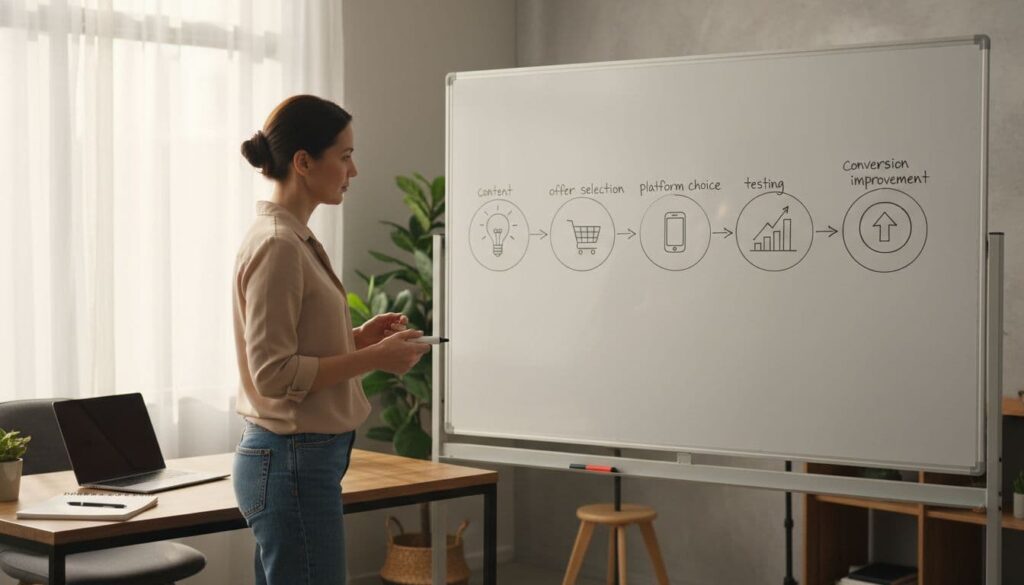
A practical workflow usually looks like this:
- Choose 3 to 5 offers that solve one clear problem for one audience.
- Pick one main platform and one support channel, such as SEO plus email, or short video plus a blog.
- Create decision-stage content first, because that content converts faster.
- Test your links, calls to action, and page structure.
- Review your numbers weekly, then improve the weakest step.
Build content around reviews, comparisons, tutorials, and real use cases
Some content gets attention, while other content gets sales. In affiliate marketing, reviews, comparisons, tutorials, and real use cases usually do both because they help people make a choice.
Match the format to buyer intent. If someone is close to buying, a review or comparison works well because they want clarity. If they’re still figuring things out, a tutorial or use case helps them see the product in action.
Here is the simple match:
- Reviews work best for people who already know the product name.
- Comparisons work best when buyers are choosing between two or three options.
- Tutorials work best when the product needs a quick explanation.
- Real use cases work best when people need proof that the tool fits daily life.
This is where trust is won. Use the product yourself when you can. Add screenshots, quick examples, simple before-and-after results, or a short note about what worked and what didn’t. That proof doesn’t need to be fancy. It just needs to feel real.
The closer your content gets to a real buying decision, the easier clicks turn into commissions.
Use AI to move faster, but keep your voice and judgment human
AI can save you hours, but it shouldn’t write your whole business for you. Use it for the parts that slow you down, not the parts that build trust.
For example, AI can help you:
- organize keyword ideas into content clusters
- draft rough outlines for reviews and tutorials
- test different hooks, titles, and email subject lines
- repurpose one article into social posts or short scripts
That said, don’t publish generic AI copy and hope it ranks or converts. Readers can feel when a post has no real opinion, no examples, and no judgment. It reads like cardboard. In 2026, that hurts trust fast.
The smart move is simple. Let AI help you move faster, then add the part only you can add, your take, your examples, your cautions, and your clear recommendation.
Track what leads to clicks, leads, and sales, then improve one step at a time
You don’t need a huge dashboard. You need a few numbers that tell you where the leak is. Start with traffic quality, click-through rate, conversion rate, earnings per click, and refund patterns.

Use them like this:
- If traffic is high but clicks are low, your angle or call to action is weak.
- If clicks are strong but sales are low, the offer or landing page likely misses the mark.
- If EPC is low, your content may attract the wrong audience.
- If refunds are high, stop pushing that offer hard, even if commissions look good.
Keep the process boring and steady. Change one thing at a time, such as the headline, button text, content angle, or offer placement. Then watch what happens. Small gains stack, and that’s how a real affiliate system grows.
The biggest mistakes to avoid if you want long term affiliate income
Long-term affiliate income usually breaks for simple reasons, not flashy ones. You don’t need one perfect trick. You need to avoid the habits that quietly kill trust, traffic, and repeat sales.
Most of the damage comes from weak content, overdependence on one platform, poor disclosure, trend-chasing, and bad tracking. If you treat affiliate marketing like a real business, not a shortcut, you give yourself a much better shot at steady income.
Thin content and forced recommendations are easier than ever to spot
Readers can tell when a post exists only to push a link. So can search platforms, social platforms, and affiliate programs. If your content feels copied, vague, or padded with empty claims, people bounce fast.
That problem is getting worse because shallow content is easy to produce now. Anyone can publish a fast summary. Very few people add real use, clear opinion, and honest detail. That’s where your edge comes from.

Think about the difference. A thin review says a tool is “great for productivity.” A useful review shows who it’s for, what it does well, where it slows you down, and when a cheaper option makes more sense. One sounds like an ad. The other sounds like help.
If you want stronger results, base your content on things readers can feel:
- your own use or close research
- simple examples and real outcomes
- clear pros, cons, and limits
- honest fit for the right buyer
Helpful content ages well. Forced recommendations expire fast.
This also protects you from a common trap, chasing every new product because the payout looks good. If you wouldn’t suggest it to a friend, don’t build content around it. Short-term clicks aren’t worth long-term doubt.
One traffic source can disappear fast, so diversification matters
Relying on one channel is like building your house on one narrow post. It may stand for a while, but one hard shake can crack everything. That’s why long-term affiliates spread risk early, even if they start small.
For example, if most of your traffic comes from Google, one ranking drop can cut your clicks in half. If you depend on TikTok, a reach change or account issue can slow sales overnight. If one affiliate program carries most of your income, a payout cut or policy change can hit just as hard.

You don’t need to be everywhere at once. However, you do need more than one path to a sale. A simple mix works well:
- a site or blog for search and evergreen content
- an email list you control
- one social platform for reach
- more than one solid offer in your niche
That last point matters more than many people think. If one software program changes terms, you should still have another trusted option. If one product goes cold, your whole income shouldn’t go with it.
In other words, don’t build on rented land alone. Owned channels and multiple offers give you room to recover, test, and keep growing.
Trust, disclosure, and compliance are part of the business now
Trust isn’t a nice extra anymore. It’s part of conversion. People click more when they believe you, and they come back when you stay clear and honest.
That starts with simple affiliate disclosures. Tell readers when a link may earn you a commission. Keep it easy to see and easy to understand. Hidden disclosures don’t make you look smart. They make you look slippery.

You also need to stay honest with claims. Don’t promise results you can’t support. Don’t blur the line between opinion and fact. If a tool has limits, say so. That honesty often lifts conversions because readers trust the rest of what you say.
Keep the basics tight:
- Use clear affiliate disclosures near links or recommendations.
- Follow the platform and program rules you joined.
- Respect privacy, especially with email signups and tracking.
- Check your analytics, so you don’t keep pushing weak or misleading offers.
A lot of affiliates lose momentum because they ignore these basics while chasing trends. That’s backwards. Durable income comes from credibility, clean practices, and measured decisions, not from squeezing a few extra clicks out of gray areas.
Frequently Asked Questions About Affiliate Marketing in 2026
What still works in affiliate marketing in 2026?
What still works is clear, trust-based content that helps people make a buying decision. Reviews, comparisons, tutorials, and real use cases still convert well because they answer specific questions and reduce doubt before the click.
Is affiliate marketing still profitable in 2026?
Affiliate marketing is still profitable when the niche solves a real problem and the offers match the audience. Long-term results usually come from useful content, repeat buyer demand, and a mix of traffic sources instead of chasing one trend or one platform.
How is affiliate marketing different in 2026 than it was a few years ago?
The biggest changes are AI-assisted content workflows, stronger creator trust, more short-form video sales, and weaker cookie-based tracking. As a result, affiliates now need better first-party data, cleaner structure, and content that works in both search engines and AI answer tools.
Why do small creators often outperform big influencers?
Small creators often win because their audiences trust them more and their recommendations feel more personal. In many niches, a niche expert, customer review, or honest demo drives more action than a polished ad from a large account.
What are the best traffic sources for affiliate marketing in 2026?
The best traffic mix usually includes short-form video for reach, SEO content for high-intent searches, and email or private communities for repeat engagement. That mix helps reduce risk and gives you both discovery and direct access to people who already trust you.
Conclusion
Affiliate marketing in 2026 is still a strong model, but it’s not a shortcut. You win when you build trust, match the right offer to the right audience, and help real people make a buying decision with clear, honest content.
That also means using AI with restraint, not as a substitute for judgment. At the same time, you need more than one traffic source, because search, social, and owned channels each play a different role in steady growth.
So keep it simple. Start with a few solid offers, publish useful content, test what gets clicks and sales, and improve one step at a time. If you stay helpful, consistent, and flexible, affiliate marketing can keep paying off long after the trends change.
Read Also: Seed Phrase Safety 101: Safe Storage Rules for Beginners in 2026
About The Author
